

We are just in the middle of OTAs and Mailk Willis is a getting called a bust
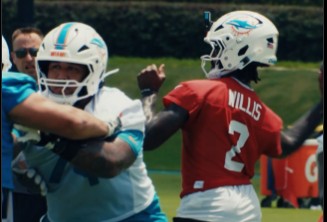
The Miami Dolphins offense is already drawing criticism during OTAs, and Malik Willis has barely unpacked his bags.
Reports of an inconsistent passing game, overthrown receivers, and offensive struggles have triggered the usual early panic among portions of the fan base. But before Dolphins fans start declaring Willis a bust or Jeff Hafley and Sullivan failures, it’s important to understand the environment Miami is currently operating in.
Right now, the Dolphins are running one of the least favorable possible setups for evaluating a quarterback and passing offense.
So, we need to see the situation in context. Not loss over Willis as he progresses, but also not to heap undue negativity.
Simply evaluate accurately step by step.
Setting the Context of OTAs
Miami is not leaning on its run game yet — the very thing this offense is supposed to be built around. In fact, they aren’t running the football at all. De’Von Achane is absent, the offensive line is still being sorted out, and defenses know passing situations are coming. Defensive backs are sitting on routes, recognizing concepts, and playing aggressively because there’s little threat of a balanced attack.
That matters.
Modern NFL defenses are increasingly designed to force offenses into patient, efficient football. The days of constant explosive passing attacks are fading as defenses prioritize coverage shells and dare teams to run the ball consistently. League-wide passing numbers have dipped as a result, and Miami appears to be intentionally building an offense designed to counter that trend through physicality, play action, and offensive line improvement.
That’s why judging Malik Willis strictly off OTA passing sessions is dangerous.
Willis has been told stay in the pocket and is in a throw only offense with new receivers in a new system.
Quarterback chemistry takes time. Receivers and quarterbacks are not simply throwing to each other — they are throwing to anticipated leverage, spacing, timing, and trust. Willis is still developing that relationship with a largely reworked group of receivers and tight ends. Meanwhile, coaches are reportedly asking him to stay in the pocket and operate within structure rather than immediately relying on mobility.
You can bet with the best pay per head that the real evaluation will come later.
The Time is Coming Fast for Real Evaluation
Training camp, joint practices, and preseason action will offer a much clearer picture once Miami’s run concepts, blocking schemes, and full personnel packages are installed. The Dolphins believe the offensive line and run game are supposed to drive everything offensively. Until that foundation is visible, the passing game may continue looking uneven.
One player generating growing optimism internally is Jamaree Salyer.
The versatile lineman may become one of the more important pieces on Miami’s roster. With Austin Jackson’s health remaining uncertain, Salyer could emerge as a legitimate option at right tackle — and perhaps even push for a starting role outright. The Dolphins appear increasingly focused on building a deeper, more physical offensive front than they’ve had in recent seasons.
That doesn’t guarantee success.
Willis still must prove he can become a functional starting quarterback.
Sullivan and Hafley ultimately will be judged on whether these evaluations and roster decisions translate into wins.
But at this stage of the offseason, the smartest approach is patience rather than extremes.
The Dolphins may not become an elite offense overnight. But if the offensive line stabilizes, the run game takes shape, and the play-action system begins functioning the way Miami intends, the entire perception of this offense could change quickly.
At least this is the hope.
We’ll know for sure soon enough…just not yet.
Go Phins!!!