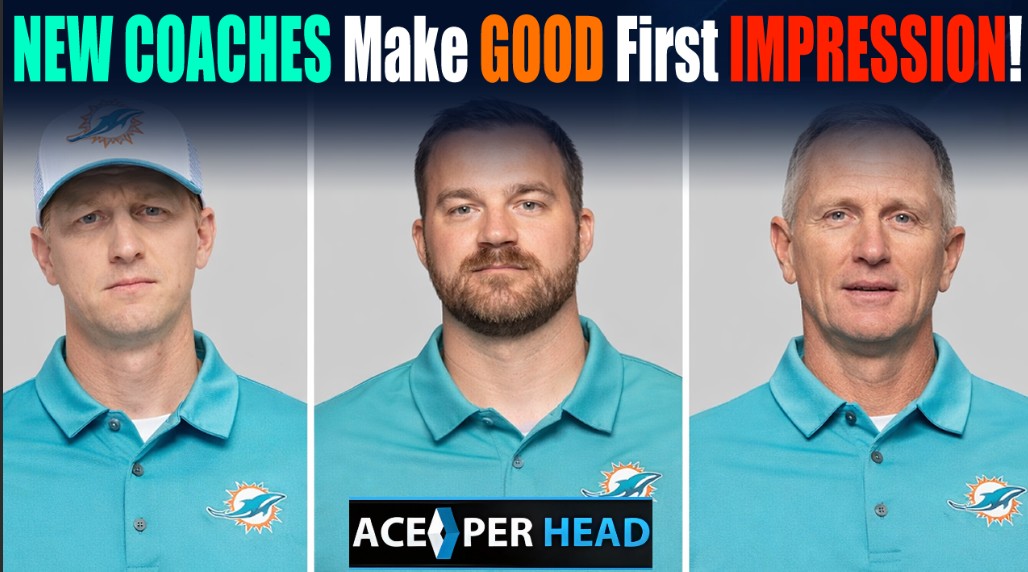
New DC Duggans & new OC Slowik both focused on the trenches
Listening to the Miami Dolphins new coaching staff speak Tuesday, one theme cut through everything else: identity before tactics. For a franchise long defined by speed and finesse, the language coming from the podium sounded deliberately different — tougher, more physical, and unapologetically grounded in fundamentals.
The great news is they kept the focus on the trenches on both sides of the ball.
Slowik: ‘Offense is About Being Physical’
Offensive coordinator Bobby Slowik framed Miami’s offense as part of the broader Shanahan coaching tree, but with an important caveat. The “bones,” as he put it, are the same — wide-zone principles, layered play-action, multiplicity — yet the final product is always player-dependent. Every branch of the tree grows differently. Scheme, in other words, is secondary to personnel.
That philosophy explains Slowik’s repeated emphasis on the run game and the offensive line. All successful teams run the ball, he said, and everything starts up front. When Slowik watches film after a game, the first thing he looks for isn’t explosive plays or quarterback metrics — it’s whether the offensive line is displacing defenders. That, he stressed, is the foundation of everything else. Physicality, violence, and toughness aren’t buzzwords; they’re prerequisites.
Slowik on the QB Situation
Slowik struck a notably patient tone when discussing the quarterback room. He believes Tua Tagovailoa can find his way back to success, citing multiple factors behind last season’s struggles rather than a single point of failure. Now is this to shine up Tua for a trade or are they planning to give him one more shot?
On Quinn Ewers, Slowik acknowledged growth over a short sample while emphasizing that real competition is supposed to feel uncomfortable — that discomfort is part of development, not a red flag. Clearly, Ewers will be a piece going forward, but you can bet with the best pay per head that what they do with Tua and in this draft will certainly play a major part in the equation.
Tactically, Slowik described his job as keeping defenses off balance: varying formations, changing tempo to the line, and tailoring play calls to exploit opponent-specific weaknesses. Few players embody that flexibility more than De’Von Achane, whom Slowik praised not just for explosiveness, but intelligence. “One mistake sticks for six weeks,” he noted — a compliment to Achane’s discipline as much as his speed.
Duggans: Hafley’s Right Hand Man
On defense, coordinator Sean Duggan echoed the same identity-first mindset. His mantra was simple and repeated: play fast. That speed starts with stopping the run, then generating pressure, and only then letting coverage take over. Duggan emphasized adapting scheme to player strengths, not forcing players into rigid roles, and spoke passionately about the coaching profession itself — investing in players and competing against other coaches. He singled out Jordyn Brooks as an inspiring presence and a cornerstone of the defensive culture.
Special teams coordinator Chris Tabor provided the day’s sharpest edge. Responding to a reporter’s knock about special teams’ coaches as head-coach candidates, Tabor rattled off a blunt reminder: Bill Belichick, Mike Ditka, Bill Cowher, and the Harbaugh lineage all began on special teams. The message was clear: leadership paths aren’t narrow — and neither is Miami’s new vision.
Taken together, the Dolphins appear to be changing more than schemes. It’s only words at this stage but taken at face value it seems to be attempting to redefine what the model of success looks like in South Florida — starting with the trenches, built on competition, and anchored in physical, disciplined football.
Don’t know what will become of this regime, but at the very least their menu sure does sound tasty!