

Jon Eric Sullivan revealed some juicy details on the 2026 offensive line
The Miami Dolphins’ offensive line overhaul is beginning to take shape—and according to insights from John Eric Sullivan, the real story isn’t just who’s starting, but what kind of line Miami is trying to build.
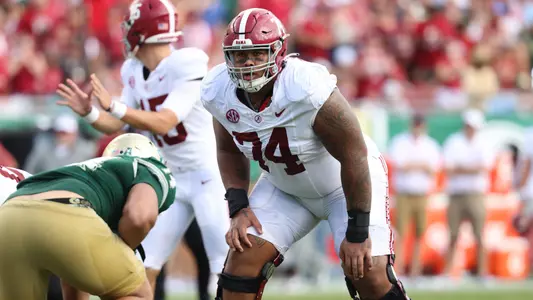
At the center of that vision are two players: Kayden Proctor and Jonah Savaiinaea. Sullivan revealed, Proctor will start at left guard and Savaiinaea will move to the right side.
So, we now have our starting five entering camp, LT Paul, LG Proctor, C Brewer, RG Savaiinaea, and RT Jackson.
This doesn’t mean it will end up that way, but at least the picture of this starting offensive line entering camp is clear.
Proctor Is the play Sully Wanted
Proctor may have been a surprise selection to some, but Sullivan’s comments make it clear this was anything but accidental. At 6’8”, 360 pounds, Proctor is an outlier physically, but also a foundational piece in what Miami appears to be constructing—a more physical, power-capable front. While he entered college as a tackle, his immediate projection at left guard is strategic.
Proctor’s size, movement ability, and power profile give Miami something it has lacked: a true anchor next to Aaron Brewer, a center known more for mobility than displacement strength. Pairing Brewer with larger guards helps offset his limitations and stabilizes the interior.
But Proctor’s role may go beyond Year 1. There’s a clear developmental arc here. Sullivan points to a Green Bay-style model—players who begin at guard, refine technique, and eventually transition back outside. Proctor’s long-term ceiling may still be at tackle, but for now, Miami is building him into a power fulcrum.
Sullivan also said Proctor is the guy they wanted all along. But only time will tell if Sullivan made the right choice to select him over Ruban Baine or Caleb Downs.
Savaiinaea will get the side he feels most comfortable with
If Proctor represents stability and upside, Jonah Savaiinaea represents volatility and opportunity.
Sullivan’s tone around Jonah is telling. While many interpret his mention as confidence, the reality may be more challenging:
This is not a coronation. It’s a spotlight.
Jonah’s athletic profile is not in question. The concern is technique—specifically stance, footwork, and hand usage. Wide base, toe positioning, and inefficient step mechanics are issues that can derail otherwise talented linemen.
The move from left to right side isn’t viewed as a major hurdle. Instead, Sullivan emphasizes that fixing foundational mechanics will determine whether Jonah holds the job or gets pushed into a depth role.
And you can bet with the best pay per head that the pressure is real.
Miami has quietly built competition behind him, signaling that no spot is guaranteed. As Sullivan suggests, the right side of the line may be where excuses end. If Jonah cleans up his technique, his natural ability could unlock “huge juice to cook with.” If not, he risks being overtaken.
Together, Proctor and Jonah illustrate Miami’s broader shift.
This is no longer just a finesse offensive line built to support speed. It’s becoming a developmental, competitive, and more physically capable unit—one that can support both the passing game and a renewed commitment to running the football.
If Sullivan’s vision holds, the Dolphins aren’t just fixing the line.
They’re redefining it.
Go Phins!!!