



Phins were supposed to be a physical running team… and they fell short of the mark by a mile

The conversation surrounding Miami’s Week 1 rushing attack has quickly become, “They don’t need to run more; they need to run more effectively.”
Fair enough. But that raises the obvious question: What determines effectiveness?
When you examine all 13 Dolphins runs, the issue wasn’t simply that Miami failed to execute. There were successful concepts available to Bobby Slowik. There were also a handful of calls that put Miami in questionable situations before the ball was even snapped.
That distinction matters.
How You Run Matters Most
The accompanying chart lays out all 13 plays, so there’s no need to repeat every result here. Instead, look at the pattern.
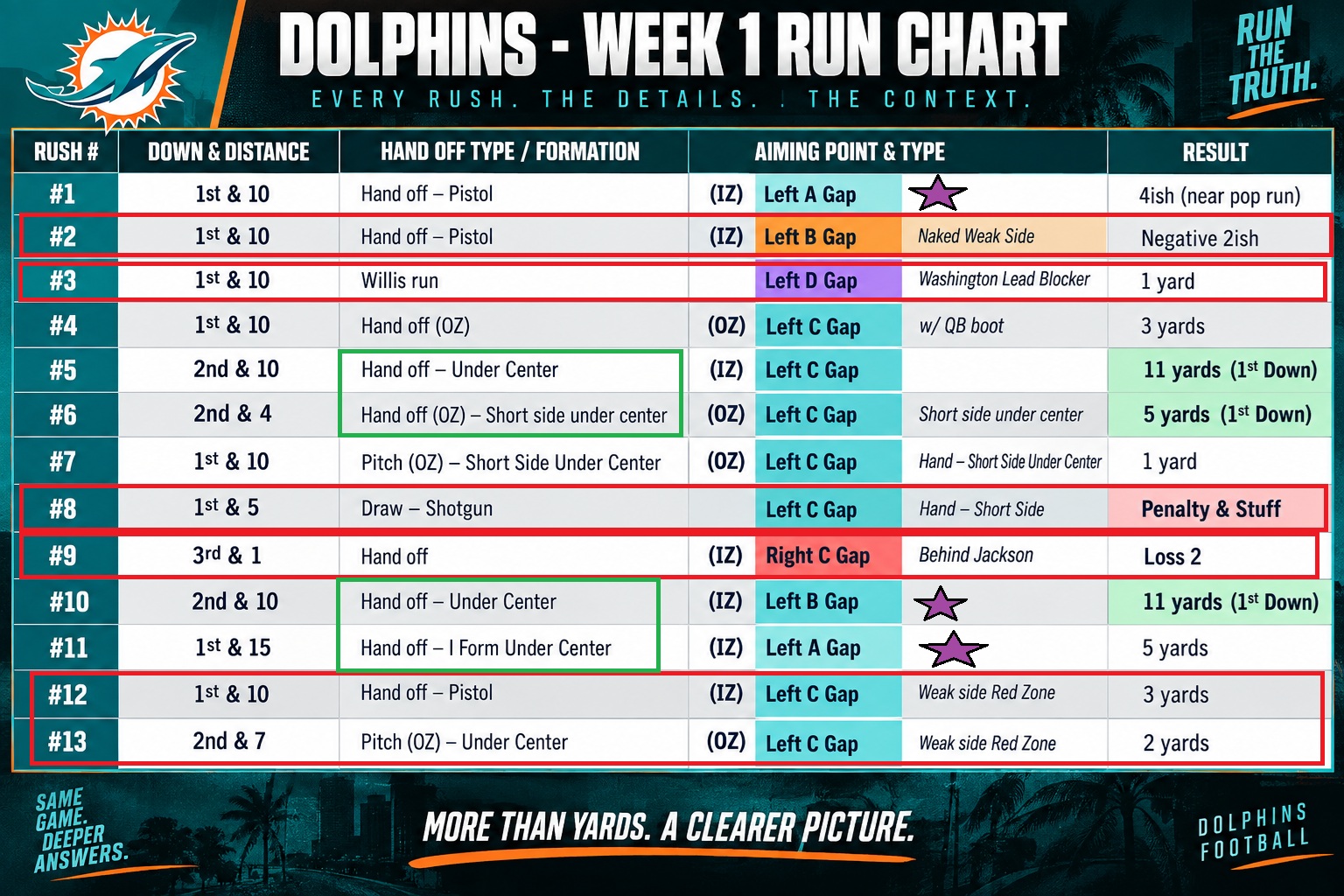
Miami found success getting under center and attacking behind the left side of the offensive line, where rookie guard Kadyn Proctor and Patrick Paul provide considerable size and power. Runs No. 5, 6, 10 and 11 produced 11, 5, 11 and 5 yards. Three resulted in first downs.
That’s not theoretical. It worked.
Yet mixed among those successful calls were several head-scratchers.
On play No. 2, Miami ran inside zone from pistol while leaving the weak-side end unblocked on the naked action. The result was approximately a two-yard loss. On another first down, Miami used Malik Willis on a designed sweep with Washington as his lead blocker. One yard.
Then came a shotgun draw on first-and-5 that was stuffed and penalized.
Perhaps the most baffling decision came on third-and-1. Miami needed one yard and had already demonstrated an ability to generate movement to the left. Instead, the Dolphins ran right, behind Austin Jackson. The play lost two yards.
Then there were the final two runs in the red zone. With the field compressed, Miami attacked the weak-side C-gap twice, including an outside-zone pitch on second-and-7 that gained only two yards.
This is why simply saying “run more effectively” doesn’t answer anything.
Offensive Coordinator Isn’t Supposed to Offensive
Effective running isn’t detached from formation, aiming point, personnel, leverage, down-and-distance or sequencing. Players have to execute, absolutely. But coaches decide what they’re being asked to execute.
And that’s where the relative silence surrounding Slowik is strange.
Miami spent an offseason talking about becoming more physical. They drafted a massive guard in Proctor and constructed an offense seemingly capable of leaning into Achane and the running game. Week 1 provided flashes of exactly that formula.
Instead of repeatedly forcing Las Vegas to stop what was working, Miami bounced between productive downhill football and concepts that seemingly worked against its own strengths.
So yes, you can bet with the best pay per head that Miami needs to run more effectively.
But before blaming effectiveness entirely on the players, there’s another question worth asking:
How did Bobby Slowik choose to run the football—and did those choices help create the ineffectiveness everyone is now criticizing?
Let’s hope he’s better Week 2!
Go Phins!!!