Chop Robinson is in a crossroads season, and he’s added size to make sure he sticks the landing
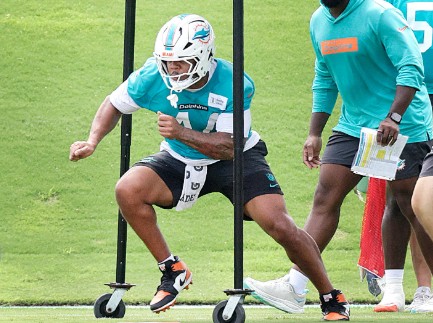
One of the most encouraging developments coming out of Dolphins minicamp isn’t a new playbook installation or a flashy highlight. It’s the physical transformation of edge rusher Chop Robinson. After an impressive rookie campaign as a pass rusher, he stalled out last season and suffered an injury. This season Robinson appears to have added significant strength and muscle this offseason—and that could be exactly what defensive coordinator Jeff Hafley wants to see…
As well as all of us Phins fans who want to see something good come out of Chris Grier’s tenure.
Chop MUST Do More than Rush the Passer
Robinson entered the NFL known primarily for his elite first-step explosion and ability to pressure quarterbacks. While those traits helped make him a dangerous pass-rushing weapon, Hafley has made it clear that becoming a complete player requires more than getting after the quarterback.
The message from the new defensive staff has been straightforward: if Robinson wants to maximize his role in Miami’s defense, he must become a more reliable run defender. Hafley has emphasized setting the edge, playing with discipline, and staying on the field in all situations—not just obvious passing downs.
The early signs suggest Robinson has embraced that challenge.
Reports place Robinson roughly 7-10 pounds heavier than last season, with his weight approaching the 265-pound range. More importantly, the added size doesn’t appear sloppy. Observers have noted larger traps, thicker upper-body development, and a stronger overall frame while maintaining the athleticism that made him such an intriguing prospect.
You can bet with the best pay per head that this added size and strength matters.
Chop Has Potential, but He MUST be a Two Tool Player
For an edge defender, improved upper-body power can translate directly into better bull-rush ability, stronger hands at the point of attack, and increased effectiveness when disengaging from blockers. Robinson’s speed has never been in question. The next step is converting some of that speed into power while becoming more difficult to move in the run game.
My comparison has always been former Chargers star Melvin Ingram. His time with the Dolphins was at the tail end of his career, but he had a period where he was an impact player.
Like Robinson, Ingram entered the league with explosiveness and pass-rush upside. It wasn’t until several years into his career that he truly blossomed into a complete defensive force. By Years 3 and 4, Ingram had refined his technique, expanded his pass-rush arsenal, and developed into a player capable of impacting every aspect of a game.
That timeline is worth remembering when evaluating Robinson.
Player development is rarely linear, particularly at edge rusher. Robinson doesn’t need to become an elite run defender overnight. If he can simply improve from liability to competent—while maintaining the burst that made him dangerous as a rookie—his value to the defense increases dramatically.
The Dolphins need Robinson to take that next step.
With veterans returning from injuries and a defense transitioning under Hafley’s leadership, Miami is searching for foundational pieces who can thrive in every situation. Robinson’s added size, commitment to improvement, and willingness to embrace coaching suggest he understands what’s being asked of him.
The pass-rushing talent is already there. If the run defense catches up, the Dolphins may be looking at one of the biggest defensive breakout candidates on the roster in 2026.