

Willis is a relatively unknown player to everyone…except Sullivan and Hafley
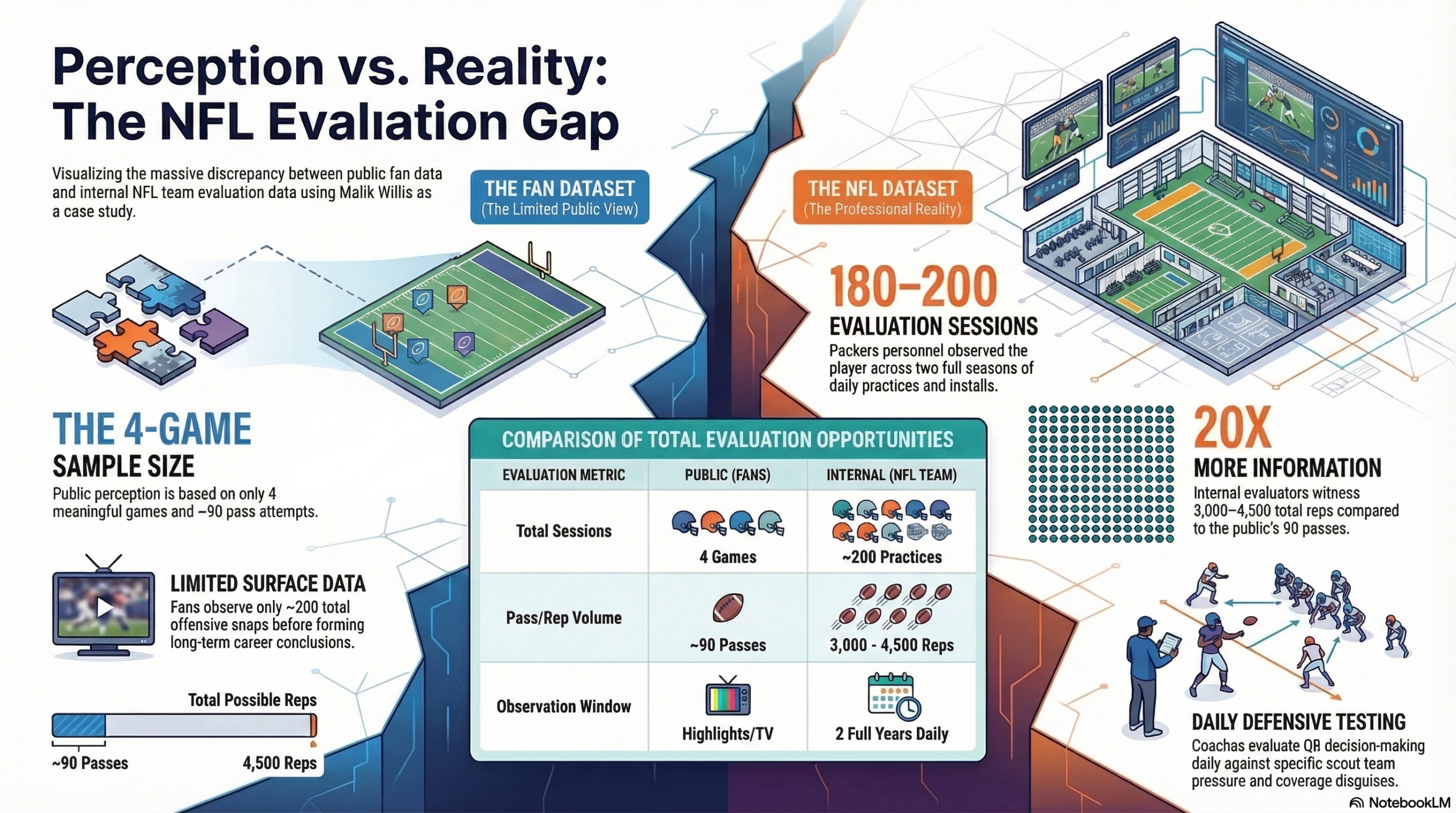
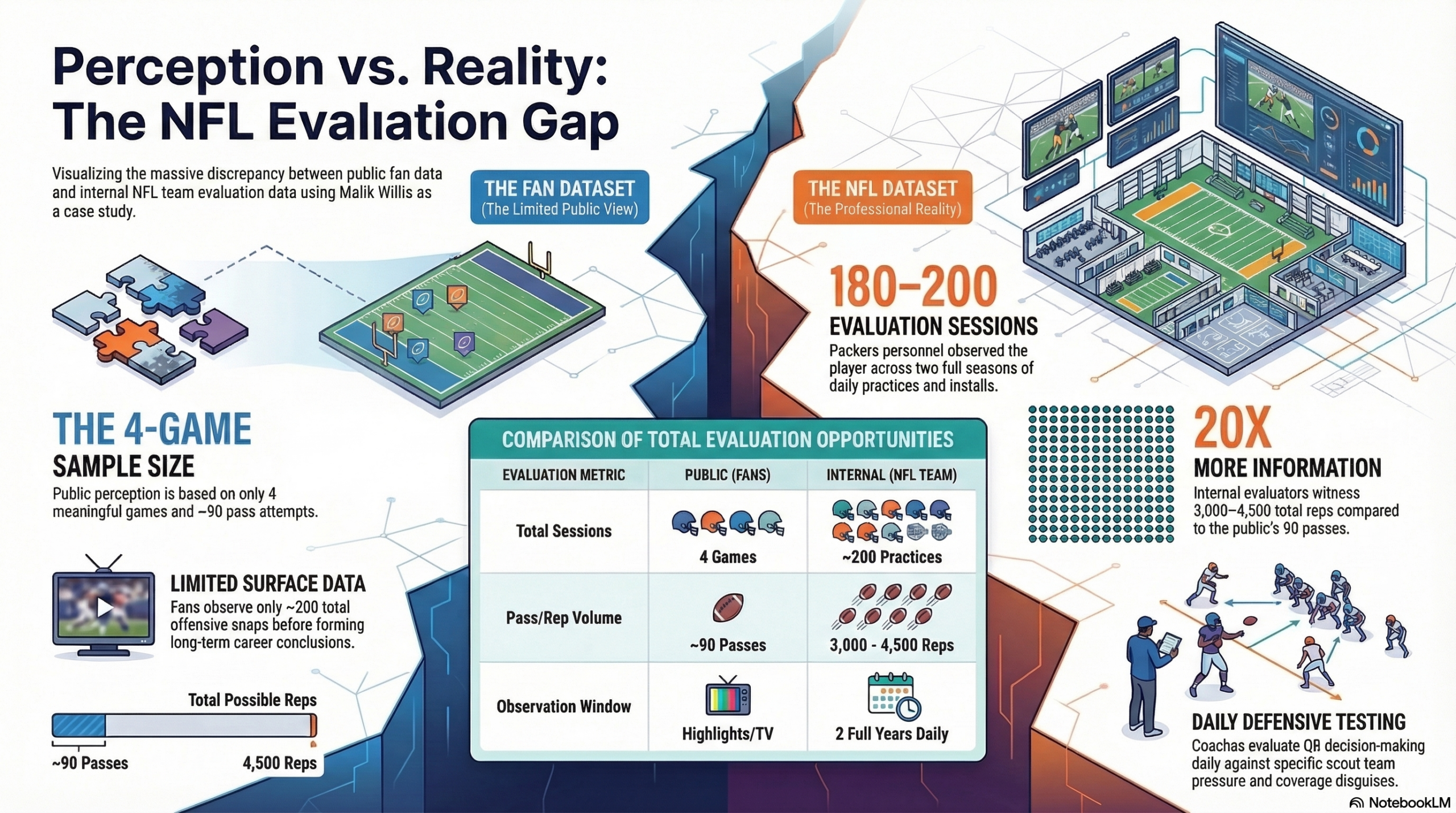
When fans evaluate Malik Willis, they are usually working with a very small sample of information. Public opinion is built almost entirely from a handful of games, a few highlights, and box scores. But the internal evaluation process inside NFL buildings is dramatically different. What teams know about a quarterback often extends far beyond what fans or media can see.
The situation surrounding Willis illustrates this gap perfectly.
Reps Count for Players & Evaluators
Most public discussions about Willis revolve around his limited game action. Fans point to roughly four meaningful starts, around 200 offensive snaps, and fewer than 100 pass attempts as the total dataset for evaluating him as a quarterback. In the public sphere, that’s the evidence available—and naturally, opinions are formed from it.
Inside NFL buildings, however, the dataset is far larger.
During the 2024–2025 seasons with the Green Bay Packers, personnel executive Jon-Eric Sullivan and defensive coordinator Jeff Hafley were able to observe Willis in ways the public never could. That observation didn’t come from game film alone. It came from training camps, regular season practices, scout-team sessions, installs, and daily work against an NFL defense.
Across two seasons, that likely meant roughly 180 to 200 practice environments. Backup quarterbacks typically take somewhere between 15 and 25 team reps per practice. Over that span, the Packers’ staff may have seen thousands of quarterback reps from Willis—potentially three to four thousand throws, reads, and decisions in live practice environments.
That difference is enormous.
Based on What Fans Have Access to, Willis is a BIG Gamble
Fans may have seen four games. NFL evaluators may have seen thousands of reps.
Hafley’s role is particularly important in that process. As defensive coordinator, his unit would have been responsible for testing Willis daily with pressure packages, disguised coverages, and scout-team looks designed to stress a quarterback’s processing and mechanics. Defensive coaches often learn more about quarterbacks during these practice battles than they do from game film alone.
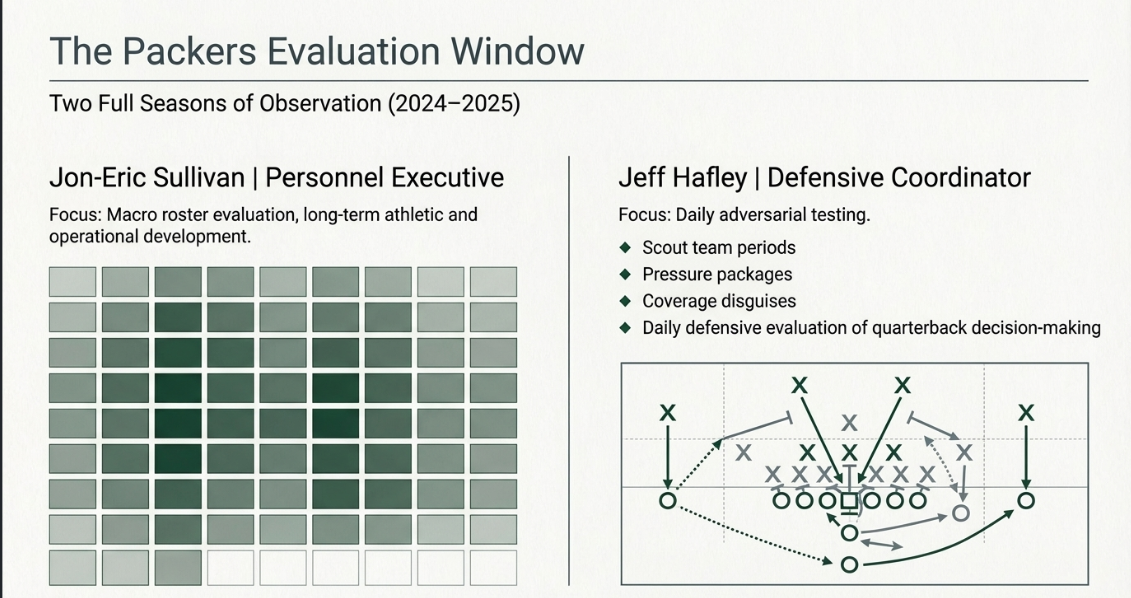
For Sullivan, whose job involves personnel evaluation and roster building, that two-year observation window becomes an extremely valuable dataset. It provides a direct look at how a quarterback handles coaching, how he improves over time, and how he performs against NFL-caliber defenses in controlled environments.
You can bank with the best football software context matters when discussing the Miami Dolphins and their decision to bring Willis into the quarterback room.
Worry Is Wise Given Our Past, But…
Some fans worry that signing Willis could mean Miami is passing on drafting a quarterback high in the future, perhaps even in the 2027 draft. But that interpretation overlooks two key realities of roster building.
First, Willis’ contract structure does not restrict the team’s ability to continue searching for quarterback talent. Teams routinely carry multiple developmental options at the position. Adding Willis does not prevent Miami from drafting a quarterback, signing another veteran, or developing young prospects already in the system.
Second, even modest development from Willis could create asset value.
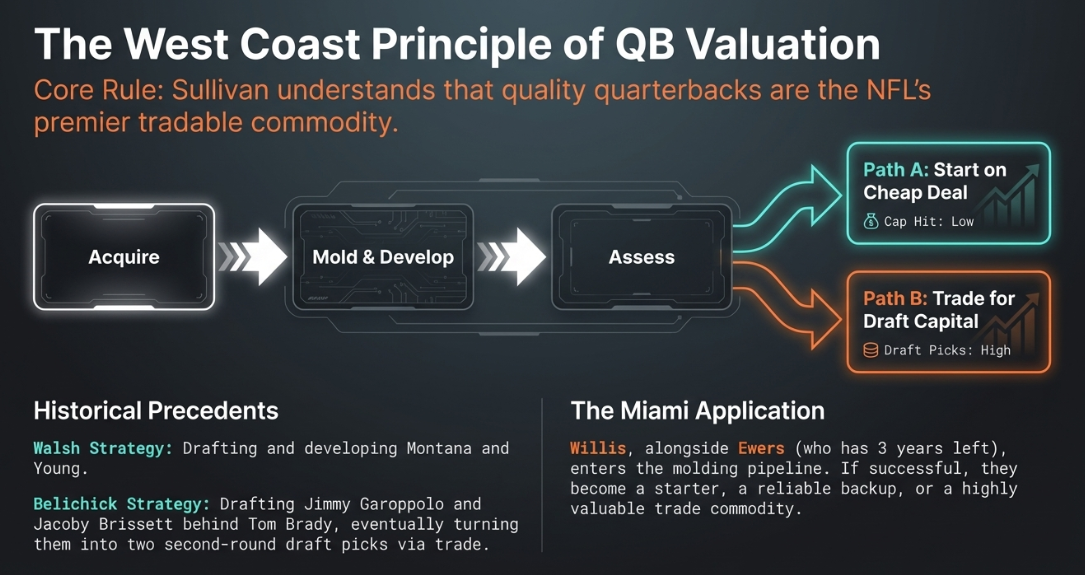
Quarterbacks hold unique trade value in the NFL. If Willis shows progress—becoming even a slightly above-average option in the right system—his value around the league could increase quickly. Teams are constantly searching for quarterbacks with starting potential or strong backup capability. In those scenarios, a player like Willis could become a tradable asset capable of returning draft capital.
That possibility gives the Dolphins optionality rather than limitation.
Miami can evaluate Willis closely while continuing to develop other young quarterbacks such as Quinn Ewers or exploring future draft opportunities. If one player emerges, the team benefits. If multiple options show promise, the front office gains leverage.
Walsh Started the Model, Green Bay & Sullivan Follow It
In modern roster construction, quarterbacks are both players and strategic assets.
The key point is that teams like Miami are operating with far more information than fans see. Public evaluation may focus on four games. Internal evaluation may include thousands of practice reps, daily coaching interaction, and years of observation.
That difference in information—the evaluation gap—is where front offices make their decisions.
And in the case of Malik Willis, the Dolphins may be betting not just on what fans have seen, but on what NFL evaluators have been studying for years.
Let’s hope they nail it.
Go Phins!!!