Willis Flops? The Bigger Problem May Be Slowik’s Offense
Willis Flops? The Bigger Problem May Be Slowik’s Offense
Phins make it close, but sloppy play has them at 0-5 on the season entering the Bye Week
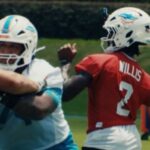
The Miami Dolphins fell to 0-4 following a 31-25 loss to the Cincinnati Bengals, and once again, the questions surrounding quarterback Malik Willis are growing louder. But while Willis deserves plenty of criticism, offensive coordinator Bobby Slowik may be the bigger problem.
Willis delivered arguably his sloppiest performance of the season. His ball security was dreadful, including a fumble and two interceptions. His tendency to hold the football too long, questionable decision-making, and discomfort on designed rollouts exposed the processing issues that have followed him throughout his career.
Yet dismissing Willis entirely ignores the flashes of ability that remain.
But that isn’t enough…and neither has Slowik’s leadership of this offense.
He Can Run & Pass Sometimes
Willis’s scrambling produced nearly 80 critical yards, while several impressive throws demonstrated his potential. One particularly memorable play saw Willis escape pressure, stiff-arm a defender, and deliver a completion to Kevin Coleman Jr.
He has some very nice on point pass scattered throughout the game. But there were two dreadful interceptions and even his normal upbeat demeanor soured and he looked like a defeated man.
The talent exists. The consistency does not.
But is Slowik helping Willis develop that consistency?
An Offensive Philosophy That Makes Little Sense
The Dolphins have the personnel to establish a physical running identity, particularly behind Kayden Proctor and Patrick Paul. Rookie running back Ollie Gordon II demonstrated exactly why he should be the centerpiece, rushing for 88 yards on 17 carries.
Nevertheless, Miami repeatedly abandoned successful rushing sequences in favor of passing situations that placed additional responsibility on Willis.
Why?
Willis attempted nearly as many passes as Joe Burrow, despite possessing nowhere near Burrow’s experience or command of an NFL offense.
Rather than establishing inside-zone runs through the A and B gaps, building manageable passing situations, and exploiting play-action opportunities, Slowik repeatedly returned to outside runs and questionable passing concepts.
You can bet with the best pay per head that the most glaring example came at the Cincinnati one-yard line.
With Jonah Savaiinaea injured, Miami overloaded the right side against a powerful defensive front featuring Dexter Lawrence. The play incorporated a pulling guard, leaving Aaron Brewer and Austin Jackson vulnerable to penetration.
The result was predictable: defensive disruption and lost yardage in a situation where protecting field position was paramount.
Why not load the left side behind Proctor and Paul, bring in additional blocking support, and challenge the defense physically?
It was a baffling decision.
The Pieces Are There, But Piece Don’t Make an Offense
Despite the offensive dysfunction, Miami has encouraging young talent.
Coleman and Malik Washington demonstrated their receiving abilities, while Caleb Douglas remains promising, although injured. Tight ends Kacmarek and Greg Dulcich contributed positively, including Dulcich’s impressive two-point conversion reception.
Defensively, there were encouraging performances from Juju Brents, Chris Johnson, and Jacob Rodriguez. The secondary generally competed well against Cincinnati’s talented receiving group.
The Dolphins aren’t devoid of talent. They’re devoid of a coherent offensive identity.
Willis may ultimately prove incapable of becoming Miami’s long-term quarterback. His flaws are real and increasingly concerning.
But Slowik’s inability to build an offense around his quarterback’s limitations and the roster’s strengths is equally troubling.