The Miami Dolphins have problems on offense. Malik Willis has his limitations, the offensive line has struggled to run on 1st Down, and with it the running game has been inconsistent. But there’s another factor that deserves serious scrutiny: the Dolphins aren’t putting that personnel in the best position to succeed.
Now if you look at the raw numbers, I might sound off base. But there is a load of padding of the stats on 3rd Down draws and Willis adding a bunch of yards.
Let’s look at the 1st Down numbers and the style of run scheme we are using and how effective it is.
The Run Game Isn’t Working on 1st Down
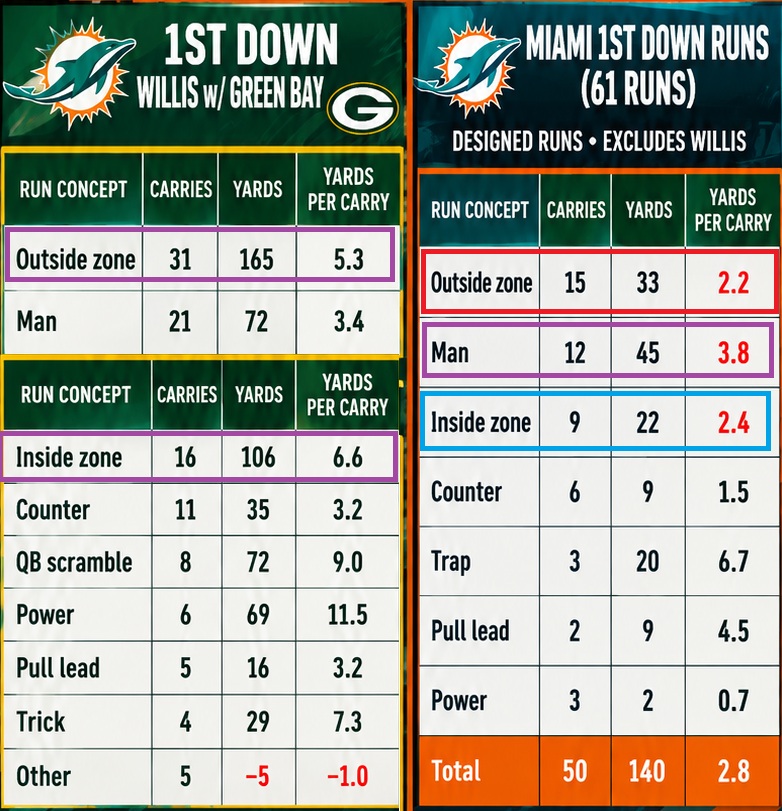
Miami has averaged just 2.8 yards per carry on its 50 charted first-down designed runs, excluding Willis.
The most troubling number belongs to outside zone, the Dolphins’ most frequently used rushing concept. On 15 first-down attempts, Miami has gained only 33 yards—2.2 yards per carry.
Inside zone hasn’t been much better, producing 2.4 yards per carry on nine attempts.
Meanwhile, man-blocking concepts have generated 3.8 yards per carry on 12 attempts.
That raises an obvious question: Why does Slowik continue emphasizing outside zone when Miami’s personnel appears better suited for a more physical, downhill approach?
Patrick Paul and Kayden Proctor are massive offensive linemen whose size and power could be better utilized attacking defenders directly rather than repeatedly asking them to execute movement-oriented concepts.
Green Bay Understood How to Help Willis
You can bet with the best pay per head that the contrast with Willis’s time in Green Bay is revealing.
The Packers generated 5.3 yards per carry on 31 first-down outside-zone attempts and 6.6 yards per carry on 16 inside-zone runs.
Green Bay’s productive rushing attack helped establish manageable situations for Willis, reducing the burden on his passing ability.
Miami is doing almost the opposite.
On first down, Dolphins quarterbacks have an average target depth of 11.9 yards, including 15.8 yards on play-action attempts.
Rather than consistently establishing manageable second downs through productive rushing and shorter passing concepts, Miami is frequently asking its quarterback to attack farther downfield.
The result? Too many second-and-long situations against defenses expecting the pass.
The responsibility of an offensive coordinator is to maximize the abilities of the players available, not force them into a preferred system regardless of results.
Miami needs more efficient first-down rushing, greater emphasis on its physical strengths, and a passing attack that creates manageable situations.
Until that changes, replacing the quarterback alone isn’t going to solve the Dolphins’ offensive problems.